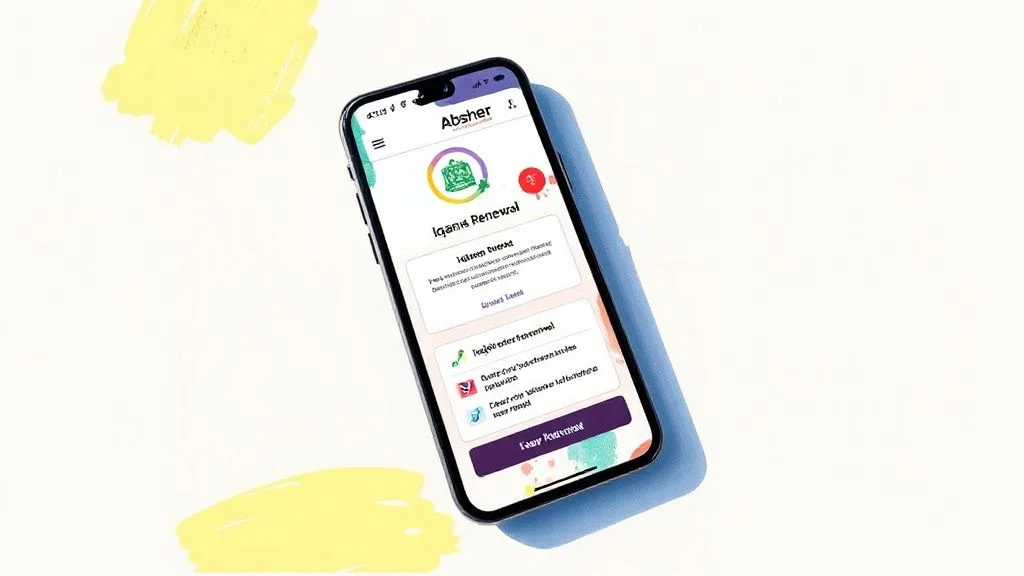
An iqama renewal is paid through Absher (absher.sa), the individual-facing government portal, but for an employed expatriate the renewal itself is normally initiated by the employer through Muqeem (muqeem.sa), the establishment-facing platform operated under the General Directorate of Passports. Knowing which side of that division you are on is the whole of the practical question. This article sets out the route, the money, and the one figure that is widely misdescribed.
What can we help you with?
Three short questions, then just how to reach you. No account needed.
The two portals, and the division between them
Absher is the individual portal: personal services, including iqama renewal payment, traffic fines and civil affairs matters, and the place where a Jawazat appointment is booked.
Muqeem is the establishment platform, used by employers and authorised representatives. Access requires the establishment's authorised manager to hold an active Absher Business account.
For an employee sponsored by a company, the renewal depends on the establishment's position — levies settled, registration current — before the individual payment can complete. So the sequence is usually: the employer settles what it owes and initiates on its side, and the renewal is then paid and completed through Absher.
The practical consequence: if your Absher renewal will not go through, the problem is frequently not yours. Ask your employer's government relations team whether the establishment's obligations are current.
The figure that is widely misdescribed
You will see the renewal described as carrying a "work permit fee of around SAR 9,600 per year". That figure is the levy, not a work permit fee.
The levy on an expatriate employee is widely reported at SAR 700 or SAR 800 per month depending on the establishment's Saudi-to-expatriate ratio. At SAR 800 a month, that is SAR 9,600 a year — which is where the number comes from. It is a monthly charge on the employer for employing an expatriate, and it is an order of magnitude larger than the iqama fee itself, which commercial guides put at around SAR 650 a year with shorter terms pro-rated. No official schedule for either figure could be verified for this article, so confirm both on Absher.
Why it matters: budgeting SAR 9,600 as your own renewal cost would be wrong by roughly a factor of fifteen, and it would also put an employer's charge on your personal account.
What you pay, and what your employer pays
Normally the employer: the work permit levy, and in most packages the iqama fee itself, as costs of employing an expatriate.
Possibly you: the dependent levy, reported at SAR 400 per month per dependent, depending on your contract.
Transaction charges: government transactions carry a service charge on the payment channel; commercial guides cite an Absher transaction charge in the region of SAR 51.75 per action.
The allocation is contractual, not statutory. The Ministry of Human Resources and Social Development's awareness guide requires the employment contract to set out the obligations of each party and requires each party to retain a copy — which is where this belongs. And if levies appear as payroll deductions that were not in your contract, that is a wage matter: the Ministry lists paying wages on time and compliance with the Wage Protection Programme among the employer's duties, and warns that failure to comply with the Programme is a violation attracting the penalties stipulated in the Law.
Renewing on time, and why the date is not negotiable
An expired iqama is not an administrative inconvenience. SAMA's Rules for Bank Accounts require the bank to record the iqama number as the customer's electronic reference and require the expatriate to hold a valid iqama; for visitors the rules state that no products or services may be provided beyond the expiry date of the identity document. The identity document is load-bearing across banking, and the renewal date is the date it stays load-bearing.
Three habits prevent trouble:
- Diarise the expiry at 60 days out, not 7.
- Check your passport's validity at the same time. A renewal generally cannot outrun the passport behind it.
- Ask your employer, at 60 days, whether the establishment's obligations are current. This is the question that surfaces a blocked renewal while there is still time.
If the renewal will not complete
Four causes, in rough order of frequency:
An establishment issue. Outstanding levies or a lapsed registration on the employer's side. Only your employer can clear it.
Unpaid fines against you. Traffic fines in particular are visible on Absher and can block a transaction. Clear them first; they are the easiest cause to fix.
A passport that expires too soon. Renew the passport first.
A record mismatch. A name or date that does not match the passport needs a correction, which runs through Muqeem or Jawazat depending on the field — and published guidance notes that a correction which cannot be resolved digitally may require a Jawazat office visit by appointment through Absher.
Dependents renew too
Dependent iqamas have their own expiry dates, and they do not renew because yours did. Diarise each one. The dependent levy continues for as long as the dependent iqamas are held, and SAMA's rules note that a dependent's iqama indicates dependent status and no authorisation to work — a status that is recorded, and that needs updating if it changes.
Use only the official portals
Published guidance on Saudi residency services warns about look-alike websites. The official channels are absher.sa for individuals and muqeem.sa for establishments. A site on another domain asking for your iqama number and passport details is not one to use, and there is no legitimate third-party route to renewing a government identity document.
What expats should know
Four points. Payment runs through Absher, but for an employed expatriate the renewal depends on the employer's position through Muqeem — so a blocked renewal is often an establishment problem, not yours. The SAR 9,600 figure attached to renewals is the annual equivalent of the monthly work permit levy on your employer, not a work permit fee you pay. Diarise the expiry at 60 days and check your passport's validity at the same time, because an expired iqama interrupts your banking. And use absher.sa and muqeem.sa only.
Primary Sources
Last updated: November 2026